Tuesday, 14 February 2012

First Reviews

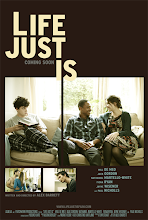
As mentioned in our previous two posts (here and here), we held our Cast & Crew screening last month. As well as inviting people who worked on the film, we thought we'd invite a few critics along so that we could start getting a sense of how the film would be received among the critical fraternity. I think the response somewhat astonished us all. Here are a few excerpts from the reviews:

* * *

'In his first feature, Barrett has already acquired the skill to know exactly where to position his camera in order to suggest a view on the material without ever imposing such a view artificially... It may be a cliché, but Barrett's key influences clearly come not from art but rather from life, from the generosity and curiosity with which he has observed both his contemporaries and himself...for it seems to me that each of the central characters represents a different aspect of their creator's personality. It is tempting to describe LIFE JUST IS as one of the most promising debuts in contemporary cinema, but this temptation should be resisted. We are not dealing with promise here: we are dealing with achievement' - Brad Stevens, Sight & Sound contributor & author of Abel Ferrara: The Moral Vision

* * *

'The sharply written and skilfully acted LIFE JUST IS explores the emotionally fraught lives of its young characters with humour, intelligence and compassion. It's a confident and impressive debut from Alex Barrett' - Philip Concannon, Phil on Film

* * *

'LIFE JUST IS will hit a nerve with those going through the post-graduate slump but also resonate with anyone trying to work out their place in the world. It is a film that will connect with its intended audience due to the strong script and great characters...

A ferociously smart and perceptive film that confronts the issues of modern life. A strong debut that is as affecting as it is funny. It is so exciting and refreshing to see a British director make a film like this' - Katherine McLaughlin, Film Critic for Cinetalk

* * *

'Barrett's film is fresh and assured...For while his film is a kind of post graduate slacker film for the 2010s generation, it is also witty, moving, charming and well-paced... He has appeared in our presence as a confident, eloquent and articulate new voice - one that will be heard of in the not-so-far future and I for one, can't wait.

LIFE JUST IS has an engaging cast who carry off the equally engaging script with style and professionalism. Everything about the film, from locations to mise-en-scene and from visual quality to direction belie the micro-budget of the production. As both writer and director, Alex Barrett has arrived and arrived with class - the barefaced cheek!' - James B. Evans, Film Critic and Author. Contributor to Electric Sheep, Little White Lies and Cinema Scope

* * *

'Barrett is unafraid to tackle ‘proper’ spiritual issues and have his characters discuss the G— word. It’s a bold move. But this doesn’t mean they spend the whole time sitting around expostulating Kierkegaardianishly: there’s room for humour and even – thank... errrr ... heavens(?) - a sort of a knob gag. Which goes to make them seem all the more normal...

LIFE JUST IS is a controlled debut from an assured filmmaker confident to make his own film in his own way' - John Riley, Film Critic for Resonance 104.4fm

* * *

'Barrett's meticulous eye elevates this beyond many of his peers... The uniformly excellent (and good looking) cast deserve to break out as a result of their work here' - Hemanth Kissoon, Filmaluation

* * *

'The film manages to be both very large in scope, discussing religion and the existence of God, and also extremely intimate. The conversations are very realistic in the way they are written and are performed naturally by the cast, which really brings the characters to life…

Ultimately, once the film had finished, I find myself wishing I could see the next day in the lives of these characters. Watch it, and you’ll feel like you’ve made some new friends' - Tom Roberts, Manager Gate Cinema, Notting Hill and writer for Cinetalk.

Friday, 20 January 2012

End of Phase One

As some of you may have gathered from the various posts and tweets that have been flying around in the last week, Life Just Is is now finished. This blog might seem like a rather low-key way to announce what is, in many ways, the summit of everything that we've been working towards... but we are all too aware that our biggest challenges still lie ahead of us: breaking onto the festival circuit and trying to secure some kind of distribution deal. Completing the film is only half the battle. We have an exciting and scary time ahead of us as we enter the second phase of the Life Just Is journey.

This time last week, we were getting ready to hold our Cast and Crew screening at BAFTA. I'm pleased to say that the evening was a great success, and so far the response to the film has been amazing (especially from critics... more on which soon). For now, though, here are a few pictures from the evening, taken by the super awesome João Serejo. Enjoy!
- Alex


Left-Right: Producer Tom Stuart, Co-Producer Pat Wintersgill, Writer/Director Alex Barrett and Exec Producer Christine Hartland.


Producer Tom Stuart (left) with Writer/Director Alex Barrett (right).


Jayne Wiserner (Jay) with Alex Barrett (writer/director).


Music Supervisor James McWilliam (right).


The pre-screening drinks reception.


Writer/Director Alex Barrett (left) with Jef Streatfield, frontman of the band Plan A, whose song Moving Along is sung by 'David' (Will De Meo) in the film.


Writer/Director Alex Barrett (left) with Editor Murat Kebir (right).


Justine Priestley (left), our Social Media Marketing Guru
 
Left-Right: Nathaniel Martello-White ('Tom'), Alex Barrett (writer/director), Will De Meo ('David'), Andrew Hawley ('Nick'), Jayne Wisener ('Jay') and Fiona Ryan ('Claire').

Joshua Osei ('Vince') with Writer/Director Alex Barrett.

Producer Tom Stuart (left) giving his intro.


Alex Barrett (Writer/Director) and Tom Stuart (Producer) giving their intros.


Writer/Director Alex Barrett giving his intro.


Actress Fiona Ryan ('Claire').


Costume Designer Charmaine Parram (left) talks to actress Fiona Ryan ('Claire', right).


Actress Alix Wilton Regan ('Zoe').

Monday, 28 November 2011

Our Soundtrack!

I decided fairly early on in the process of developing the style of Life Just Is that I didn't want to use a traditional score, and that the only music in the film would be diegetic (i.e. that it would come directly from within the world of the film in moments where, for instance, the characters themselves are listening to music on a stereo). The main idea behind this was that I wanted to avoid any kind of manipulation of audience emotion: I wanted to see if I could draw out an emotional response to the film purely through audience identification with the characters and their situations, rather than through a few strings ringing out on a soundtrack. Rereading Robert Bresson's Notes on the Cinematographer during development no doubt also contributed, with three of his maxims never straying too far from my mind:

'Build your film on white, on silence and on stillness'

'Be sure of having used to the full all that is communicated by immobility and silence'

'No music as accompaniment, support or reinforcement. No Music at all*.
The noises must become the music.
*Except, of course, the music played by visible instruments'

Conflicting with these ideas, though, was another: that of Life Just Is as a covert musical, in which characters sing to one another and in which music clearly plays an important part.

So, the point was never so much to abandon music as to use it in a way that mutually supported the characters and the story, without resorting to the falsification of the moment or fabrications of emotions that traditional scores can sometimes bring. 

With all that in mind, finding the right music for the film became extremely important.

It's therefore with great pleasure that I'm now able to announce, for the first time, our full soundtrack listing!

I know it's very easy to be hyperbolic when writing a piece like this (we are trying to promote a film here, after all), but what makes this announcement even more exciting is that some of the bands listed below are among my all-time favourites. I feel incredibly privileged to have been allowed to use their music, and I'd like to thank everyone involved for their kindness and support. I'm genuinely touched. The Wildhearts have been my favourite band since I was nine years old, and being able to use their music in my debut feature is something of a dream come true.

It was through The Wildhearts that I discovered some of the other bands listed, including Deckard, who I first came across when their singer supported The Wildhearts' frontman Ginger during an acoustic tour some seven or eight years ago, and The Jellys and Plan A (both of whom feature ex-Wildhearts members, and both of whom are now sadly inactive).

Another sadly inactive band is The Lustjunks, who were a regular fixture on my local music scene when I was growing up. I always seriously loved their stuff, and I'm glad that I was able to track them down and include them here. (I can also exclusively reveal that Andy, their frontman, is working on a new album – so that's certainly something to keep an eye out for!) Also culled from my local music scene is the terrifying, crushing behemoth that is nate_seacourt, who can currently be seen tearing apart venues across London (literally).

The rest of the bands came to me through our music supervisor, James McWilliam, and although I didn't know many of them until Jim suggested them, I'm no less excited about using their music in the film. Thanks to Jim's hard work and the generosity of the bands he contacted, I think we've managed to put together a genuinely interesting, exciting and eclectic sound track: Animal Kingdom have just finished recording their second album with producer David Kosten, The High Wire recently supported Coldplay across multiple dates during their Viva La Vida arena tour, and The Heart Strings' second album will be getting a physical release in January 2012.

Anyway, that's enough of my waffling – I'll let you have a listen for yourself...
- Alex


Music tracks and artists featured on our soundtrack, listed in order of appearance:
(Where possible, song names link to Spotify/Soundcloud tracks, band names to official websites. To download the free MP3s please right click and 'Save Target As...')


And Rear Lights - The Lustjunks (free MP3 download)


Dreaming in A – The Wildhearts


Music tracks performed/quoted by the cast of Life Just Is, listed with the names of their original artist, in order of appearance:


On My Mind - Will De Meo

Moving Along - Plan A (free MP3 download)

Lemonade Girl – The Jellys

Dreaming in A – The Wildhearts

Monday, 31 October 2011

Taking the Myth Out of Transmedia

When one of the speakers backed out of our event 'UPGRADE: Building a Creative Career in the Digital Age' last week, I started making notes in case I needed to give the speech himself. Luckily a replacement speaker was found, but rather than waste the prep work I'd already done, I decided to turn it into a vlog. It's basically a short talk in which I aim to take the myth out of transmedia and get people thinking about how they can maximise creativity, audience engagement and revenue potential. Here's the video, but for those who prefer to read rather than watch, I've included the key points in text form below. (We'll be back to our more regular type of blog/vlog posts later this week).


What is 'transmedia'? Also known as 'cross-platform' or 'multiplatform', 'transmedia' is a word used to refer to the practice of telling a story across multiple platforms and formats. An example of this would be The Matrix Reloaded, which used transmedia storytelling in two distinct ways: 1) they expanded the story itself across different media (the film and the computer game, Enter The Matrix), and 2) they used different media to expand and enrich the universe that the film takes place in (by telling other stories – in both comic books and animated shorts – set in the world of the film).

While you may not have the resources to work on a scale as large as that of The Matrix, that doesn't mean you can't think in cross-platform terms when conceiving projects: even something like a Twitter account set up and run in-character can be effective. Indeed, the possible platforms are endless: social media sites, live-action games, computer games, widgets, mobile phones, films, web shows, TV shows, live events, merchandise, websites, DVDs and comics are just some of the platforms you can consider to help tell your story.

Filmmakers have to acknowledge that the way audiences are consuming their work has changed: the sanctity of the cinema is not what it once was. Technology and the hyperactivity of the modern age have shattered it. Once this fact is acknowledged, the next step is to try and understand it and, more importantly, to try and turn it to our advantage.

Although it's true that genres like science-fiction may, in some ways, offer more obvious opportunities for a transmedia approach, it doesn't mean that opportunities aren't there for non-genre based projects too. For example, when we were in the development stage on Life Just Is, my producers and I had several conversations about the possibility of making a webseries to go along with the film. Consisting of five or six episodes, each episode would have focused on one of the film's lead characters and explored their lives in the run up to the moment at which the narrative of the film begins. In other words, the series would have offered a further emotional and psychological insight into the characters in the film by exploring some of their backstory. In addition to considering the webseries, we also discussed the possibility of telling these stories in comic strip form. Although the prequels didn't ultimately come to fruition, I was excited by the creative possibilities that they offered: as the writer/director of a film which focuses intensely on the lives of its characters, the opportunity to explore them in even greater detail was something that appealed to me.

The reason why we never took the idea of the prequels beyond the development stage was simply down to budget constraints, and when conceiving transmedia projects you will need to think about the cost of each of the different elements, not only in terms of finance, but also in terms of time.

However, while transmedia projects may well require a bigger outlay, it's also true that, potentially, they offer a greater capacity for revenue return: simply put, by creating multiple works, you have multiple products which you can monetise. And this is a key point to remember: each element you create has value within itself.

Another important consideration in conceiving a transmedia project is to think about how your audience is going to travel between platforms, and this needs to be thought about in terms of both the physicality and psychology: for example, how are they going to move from the cinema to the internet and, more importantly, what is it that is going to make them want to make that transition?

Here, perhaps, is where genre helps. Mystery aspects are a good way to hook in an audience, as is mythology: think about the buzz which surrounded The Blair Witch Project when it came out, another film which can be said to have utilized transmedia elements: again, they used the medium of comics, but they also made a television mockumentary – The Curse of the Blair Witch – which expanded upon the world of the story and made you want to know even more about it.

The use of the word 'expanded' here is key. If you want your viewers to actively engage in transmedia content, the work needs to add value to the story you're telling. It shouldn't just serve to promote a central product, but should genuinely help enrich the world and/or the characters of your story, because ultimately creating a world or characters that people want to find out more about, that people want to get to know, is going to go a long way to encouraging them to travel between platforms and seek out the further branches of your project.

Another point to remember is that not all audience members will engage with your project in the same way, so you really need to think about the way in which people will be consuming your work. Again, The Matrix Reloaded serves as a good example: half the storyline of the film was being told in other media, so viewers who weren't engaging with the project across the multiple platforms were only getting half the story. Literally. So you need to make sure that your project isn't alienating to people who only want to dip in and out, or to engage with it on only a single platform. But you also need to make sure that it's engaging enough for the viewers who do want to see everything.

One final aspect of the transmedia user experience that shouldn't be overlooked is the desire for interactivity: sitting back and watching as a passive viewer is no longer enough for many people. In his keynote speech at the Power to Pixel conference in 2009, film producer Ted Hope said that 'we have to go from giving the audience a monologue to having a dialogue with them', and many audience members do now have a desire to contribute back. Story Architect Lance Weiler has spoken about how audiences should be seen as collaborators, while Hope spoke in his keynote about seeing ourselves as enablers, not creators: we need to look at ways in which the 'crowd' can contribute to our work, and not be afraid to let our viewers create on the same level as us: why not allow the user to become the co-creator, and therefore the promoter, of our work?

There are many ways to encourage audience participation, from remix competitions to fan-fiction to crowd sourcing ideas. (For those of you who don't know, crowd sourcing means asking your followers to contribute ideas, storylines, or designs – or whatever – to your project, usually through an online community). Of course, co-creation is only one form of possible interactivity, and things like games or comment boards also invite audience involvement. But whatever approach you take, it's by turning the viewer into an active participant that you can achieve the highest level of audience engagement.

In short, the new technologies and the new ways in which projects are consumed calls for there to be new forms of interaction, and these new forms of interaction allow for increased revenue potential, increased audience engagement, and increased creative output. In other words: It is an exciting time to be a creative.
- Alex